
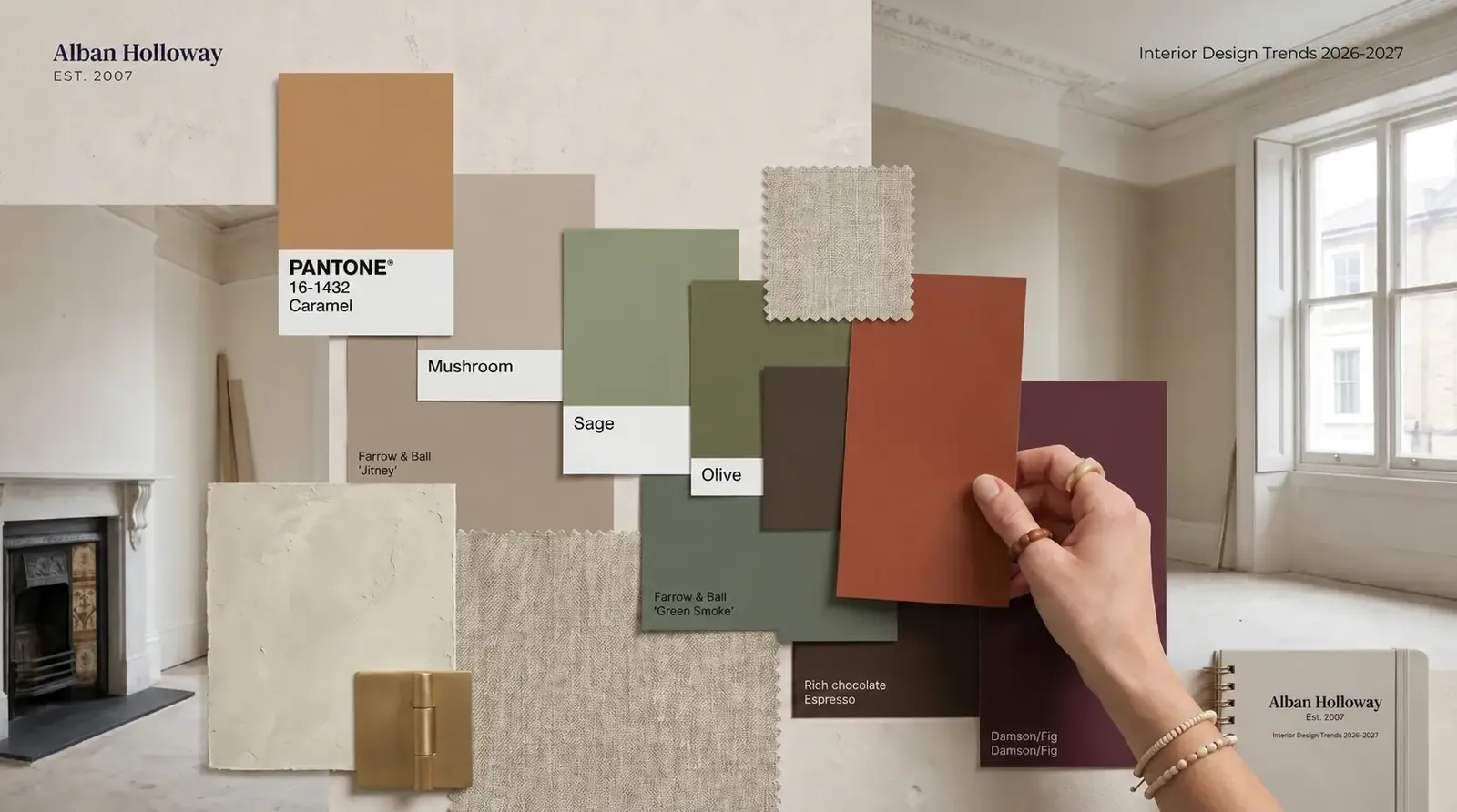
If you're planning to redecorate a London property — whether to refresh a rental between tenancies, modernise before a sale, or simply make a home feel more like yours — 2026 is a genuinely interesting moment to be making those decisions.
Current interior design trends in the UK are going through their most significant shift in a decade. The conclusion that designers and interiors professionals are drawing is clear: the grey era is over, and what's replacing it is warmer, richer, and considerably more interesting.
Here is what the latest interior decorating trends mean in practice — the colours, techniques, and design directions shaping London homes in 2026 and into 2027.
The 2026 Interior Design Trends Replacing Grey
The design world has settled on a phrase for the direction of current home decor trends: "quietly colourful." Not the bold, clashing experimentalism of the 1960s or the Laura Ashley pastels of the 1980s — but nuanced, nature-driven tones that bring warmth and personality without demanding attention.
Warm neutrals with depth
Pantone's 2026 Colour of the Year, Cloud Dancer, sets the tone — a calm, airy off-white with warmth rather than coolness. Beige has returned, but transformed: mushroom, caramel, and warm taupe tones with yellow and red undertones are replacing the cool, flat neutrals of the previous decade. Farrow & Ball's Jitney and Benjamin Moore's Swiss Coffee capture this direction well — colours that wrap a room in a soft, welcoming glow rather than a clinical blankness.
Earthy greens
Green has become the new neutral in British interiors. Sage is evolving into deeper, more grounded shades — olive, moss, and muted khaki — that bring a connection to nature and a sense of calm. Farrow & Ball's Green Smoke remains among the most specified living room colours in the UK for 2026. For London homes with sash windows and period fireplaces, these tones complement original features rather than competing with them.
Deep, saturated accents
The boldness of the 2020s is maturing. Deep espresso browns and rich chocolates are replacing charcoal and black as the anchor tones for living rooms and studies — sophisticated and grounding in a way that grey never quite managed. For accents and feature elements, the direction is heritage-inspired: burgundy, plum, damson, fig, and burnt terracotta clay are all seeing significant growth across UK paint brand ranges.
Indigo and teal
Blue is making a meditative comeback, but in a different register from the steel blues of the 2010s. Dulux's 2026 trend colours include variable indigo shades and Transformative Teal — blue-greens that bridge tranquillity and modern energy. In London's north-facing rooms and basement flats, these deeper blues can work particularly well, creating atmosphere rather than emphasising the absence of light.
Paint Techniques: What's Changed Beyond the Colour
The more interesting shift in 2026 is not just what colour goes on the wall, but how it is applied. The single feature wall — one bold wall, three neutrals — is being replaced by more architectural and immersive approaches.
- Colour drenching. Painting walls, skirting boards, door frames, window casings, and ceiling in exactly the same colour — often in a rich matte finish. The effect is cocoon-like and seamless, and counterintuitively makes smaller spaces feel larger by eliminating the visual fragmentation that comes from colour breaks. Particularly effective in hallways, studies, and bedrooms.
- Colour capping. Painting the upper portion of the walls and the ceiling in a slightly deeper shade than the lower walls. This draws the eye upward, emphasises ceiling height, and adds an architectural quality that feels considered rather than designed. A practical technique for London rooms with lower ceilings that would otherwise feel cramped.
- Statement ceilings. The fifth wall is no longer automatically white. Bringing a soft tone or a full saturating colour to the ceiling adds dimension and completes a room rather than leaving it unresolved. A warm blush or a soft teal ceiling can transform a bedroom without touching a single piece of furniture.
- Tonal zoning. In open-plan layouts — increasingly common in London renovations — subtle colour shifts define areas without physical dividers. A warm ochre living zone transitioning to a gentle sage dining area creates rhythm and purpose without walls.
- Textured finishes. Smooth, synthetic surfaces are giving way to limewash, plaster-effect, and clay finishes that have depth and movement. These work particularly well in Victorian and Edwardian London properties, where the irregularity of the walls already gives character.
Thinking of redecorating your London property?
Alban Holloway delivers full-service decoration and renovation across London — from single-room refreshes to complete property transformations aligned with the 2026 palette.
Get Your Free Decoration QuoteThe Broader Design Direction: Modern Heritage
The overarching movement shaping London interiors in 2026 has been named "Modern Heritage" by designers — a sensibility that bridges the past and the present without pastiche.
In practice, this means pairing classic architectural details — original cornicing, dado rails, period fireplaces, sash windows — with clean, contemporary furnishings and a deliberately considered palette. It values spaces that feel accumulated over time rather than installed from a showroom. For London homeowners in Victorian and Edwardian properties, this is genuinely good news: the period features that were sometimes seen as obstacles to modernisation are now design assets.
Two practical expressions of this direction:
- Mixing wood tones. Matching all timber finishes is out. The more interesting approach mixes light, medium, and dark woods — white oak flooring with walnut cabinetry, for instance — to create depth and material richness. Original timber floors in London period properties are a natural starting point.
- Tactile, authentic materials. Woven blinds, handmade ceramics, unlacquered brass hardware, natural linen — the shift is toward surfaces that have texture and age gracefully, rather than the smooth, low-maintenance finishes that dominated the 2010s.
What These Interior Trends Mean for London Properties Specifically
For landlords, homeowners, and anyone preparing a London property for the market, the shift away from grey has practical implications beyond aesthetics.
- Pre-sale and pre-let decoration. A freshly decorated property in a dated neutral reads as tired before a viewer has processed a single room. Updating to a current warm palette — even just warm whites and soft earthy greens — is one of the most cost-effective improvements available. The cost of redecorating a London flat is typically £1,500–£4,000 depending on size and finish; the impact on first impressions is disproportionate. For a full breakdown of returns by project type, see our guide to home renovation costs in London 2026.
- Period properties. London's Victorian and Edwardian stock responds particularly well to the 2026 palette. Warm greens, deep blues, and earthy terracottas complement original brick, timber, and plasterwork in a way that cool grey never did. If you've been living with grey walls in a period property, the case for change has rarely been stronger.
- Rental properties. The shift toward warm neutrals also benefits landlords. Mushroom, caramel, and warm off-white tones are broadly appealing, photograph well, and are less likely to feel dated in three years than the cool greys that currently date many rental properties. Combined with planned property maintenance, redecoration is one of the highest-impact interventions between tenancies.
FAQ: Interior Design Trends London 2026–2027
Is grey still in style for 2026? No. After a decade of dominance, cool grey is widely considered dated by London designers and paint brands. The 2026 palette replaces it with warm neutrals and earthy tones that bring depth and personality.
What is colour drenching? Colour drenching means painting walls, skirting boards, door frames, window casings and ceiling in exactly the same colour, usually in a rich matte finish. It makes small London rooms feel larger, not smaller.
Which 2026 colours suit Victorian and Edwardian properties? Warm greens (Farrow & Ball Green Smoke), deep blues like Inchyra Blue, warm off-whites and earthy terracottas complement original cornicing, sash windows, fireplaces and timber floors.
How much does it cost to redecorate a London flat? Typically £1,500–£4,000 depending on size, finish and preparation. One of the most cost-effective improvements before a sale or new tenancy.
Planning a decoration or renovation project in London?
At Alban Holloway, we work with London homeowners and landlords on decoration and residential renovations — from a single-room refresh through to full property renovation, kitchen and bathroom upgrades, and pre-sale preparation.
We can arrange a site visit and provide a free, no-obligation quote.
Alban Holloway Ltd is a London-based property services company specialising in residential renovations, decoration, property maintenance, EPC compliance, and block management across London.