
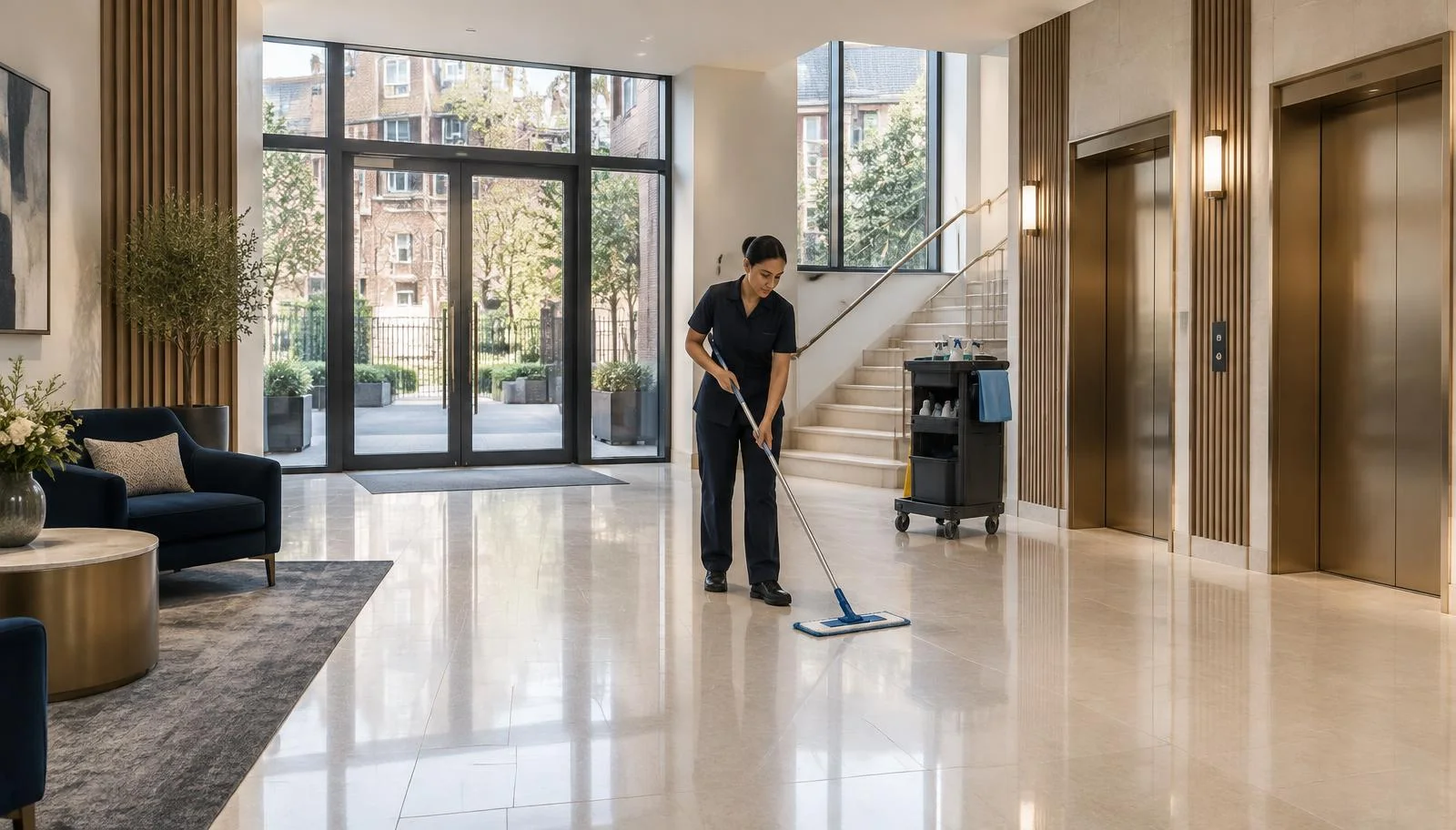
Communal areas are the part of a London block every resident passes through several times a day, and they are also the fastest way a managing agent's standards become visible — for better or worse. A dusty lobby or a lift that hasn't been wiped down in a week doesn't generate a maintenance ticket. It generates a complaint, and often an assumption that if the visible things are neglected, everything else is too.
Cleaning is also a legal obligation, not just a presentation choice. The Housing Act 2004, the Landlord and Tenant Act 1985 and fire safety regulations all require communal areas to be kept clean, safe and in good repair, with documented schedules. And the chemicals used to do it are subject to their own compliance regime — one that HSE enforces with real consequences, as a 2026 prosecution makes clear.
This guide covers what a defensible communal cleaning programme looks like for a London block in 2026: the areas it needs to cover, how to set the right frequency, the COSHH obligations that sit underneath it, and why cleaning quality is one of the more direct levers a managing agent has over resident satisfaction and complaint volume.
What a Communal Cleaning Programme Should Cover
A comprehensive specification covers entrance halls and lobbies, stairwells and landings on every floor, corridors, lifts (walls, floor and buttons), bin storage areas, car parks and garages, shared gardens and outdoor seating, intercom panels and door entry systems, post rooms, and cycle stores. Different areas need different frequencies depending on footfall and how quickly they show wear.
Setting the Right Frequency
| Block Type | Typical Frequency | Notes |
|---|---|---|
| Large blocks with lifts, high footfall | Daily or 3x weekly | Entrance and lift are the highest-visibility, fastest-soiling areas |
| Medium-sized blocks | Twice weekly | Most common specification for standard London blocks |
| Smaller blocks, lower footfall | Weekly | Still requires a documented, consistent schedule |
| Very small blocks / minimal common parts | Fortnightly (minimum) | Each visit needs to be thorough to prevent build-up between cleans |
Beyond the regular schedule, most blocks benefit from periodic deep cleaning — quarterly, semi-annual or annual depending on size and usage — covering high-level areas, detailed floor treatment and anything the routine visit maintains rather than restores.
Costs vary significantly by scope: a small block under 10 units typically runs £150–£400 per month, while larger London developments with daily cleaning can exceed £2,000 per month. A written specification, benchmarked against recognised standards such as BICSc, is the clearest way to check whether a quote reflects the actual scope needed rather than a generic package.
COSHH: The Compliance Layer Behind Every Cleaning Contract
Cleaning chemicals are among the most commonly used hazardous substances in any workplace, and the Control of Substances Hazardous to Health Regulations 2002 (COSHH) apply regardless of block size — there is no minimum threshold. Whoever carries out or oversees the cleaning must identify the substances in use, assess the risks, and apply appropriate controls, with a written record required once five or more people are involved in the work.
This isn't a paperwork formality. A 2026 HSE prosecution saw a company fined £3.8 million, plus £124,748 in costs, after two workers suffered serious caustic soda burns at separate sites — a breach of COSHH Regulation 7(1). Separately, the Chemicals (Health and Safety) (Amendment, Consequential and Transitional Provision) Regulations 2026 introduced updated GHS labelling obligations from August 2026, affecting how cleaning contractors must label and document any chemicals transferred into secondary containers.
For a managing agent, the practical question to ask any cleaning contractor is simple: can they produce Safety Data Sheets and a current COSHH assessment for every product used in your block, on request? If not, that liability sits with whoever commissioned the work as much as the contractor carrying it out.
Reviewing your block's cleaning specification?
Alban Holloway provides fully COSHH-compliant communal cleaning for London managing agents and RMCs, with documented schedules and Safety Data Sheets available for every product used.
Get a Quote for Block Management Cleaning ServicesWhy Cleaning Quality Drives Resident Satisfaction and Complaint Volume
Communal cleaning sits alongside PPM as one of the few maintenance areas residents genuinely notice, because it's visible on every single pass through the building. A neglected lobby or stairwell doesn't just look poor — it lowers perceived property value, undermines confidence in the wider management of the block, and is a recurring theme in the leaseholder complaint categories we covered in our guide to reducing leaseholder complaints.
The reverse is also true. Consistent, documented cleaning — ideally with the same cleaner attending each visit to maintain familiarity and standards — is one of the more cost-effective ways to protect resident satisfaction relative to its cost, and gives the managing agent a clear paper trail (schedules, sign-off records) if a complaint does arise. A coordinated property maintenance programme and a documented PPM schedule provide the same visibility across the wider block.
FAQ: Communal Cleaning for London Managing Agents and RMCs
How often should communal areas in a London block be cleaned?
It depends on block size and footfall. Large blocks with lifts typically need daily or three-times-weekly cleaning, medium blocks often work well with twice-weekly, and smaller blocks may manage with weekly or, as a minimum, fortnightly cleaning.
Is communal area cleaning a legal requirement?
Yes. The Housing Act 2004, the Landlord and Tenant Act 1985 and fire safety regulations all require communal areas to be kept clean, safe and in good repair, with documented cleaning schedules.
Does COSHH apply to residential block cleaning?
Yes, regardless of block size. The Control of Substances Hazardous to Health Regulations 2002 require risk assessment and control measures for any hazardous cleaning chemicals in use, with a written record required for larger operations.
How much does professional communal cleaning cost in London?
Costs vary by scope and frequency: a small block under 10 units typically costs £150–£400 per month, while larger developments with daily cleaning can exceed £2,000 per month.
Does cleaning quality actually affect leaseholder complaints?
Yes. Communal areas are the most visible part of block management to residents, and poor cleaning standards are a recurring driver of dissatisfaction and complaint volume, alongside service charge transparency and communication.
Get a Quote for Block Management Cleaning Services
Alban Holloway Ltd supports London managing agents and RMCs with documented, COSHH-compliant communal cleaning programmes tailored to each block's footfall and specification.
Alban Holloway Ltd is a London-based property services company specialising in property maintenance, PPM programmes, block management support, Section 20 major works, and EPC compliance across London.